Farming has always been a demanding job. If you’ve spent any time in a tractor cab, you know the drill: long hours, intense concentration, and the constant pressure to drive a perfectly straight line. Whether you are planting, spraying, or tilling, the need for absolute precision is physically and mentally exhausting.
As we move into 2026, more farmers are realizing that they don't have to "tough it out" anymore. Modern tractor guidance and autosteering systems are changing the game. These tools aren't just about straight rows; they are about making work safer, more comfortable, and much less stressful—day and night, field after field.
Why Fatigue and Human Error Are Real Risks?
Driving a tractor for 10 or 12 hours straight takes a toll. When you use manual steering, your brain is constantly making micro-corrections to stay on track. This constant focus leads to operator fatigue faster than you might realize.
When fatigue builds up:
- Concentration fades: You might miss a row or overlap a pass.
- Reaction time drops: This increases the risk of damaging expensive equipment or implements.
- Stress increases: Trying to maintain precision while tired leads to burnout.
Without support from a guidance or autosteering system, the risks to both your performance and your safety grow with every hour on the clock.
What Are Tractor Navigation Systems?
Think of a tractor guidance and autosteering system as a high-tech assistant. These systems use GPS (GNSS) signals to help you drive more accurately. They generally fall into two categories:
- Manual Guidance (like the FJD AG1): This system uses an easy-to-use control screen to show you exactly where to steer. It keeps you on track visually, ensuring you don't skip areas or overlap.
- Autosteering (like the FJD AT2 Lite): This system takes over physical steering. It automatically turns the wheel to follow a precise path, allowing you to keep your hands free to monitor the implement and the field conditions.
A typical setup includes a GNSS receiver on the roof and a control tablet in the cab. These tools allow for consistent fieldwork, regardless of how tired the operator might be.
How Navigation Systems Improve Safety?
Field conditions are rarely perfect. Dust, fog, and darkness can make it nearly impossible to see your physical markers. A GPS system for tractor reduces these risks by keeping the machine on track automatically.
- Night Farming Operations: With autosteering, you can work just as accurately at 2:00 AM as you do at 2:00 PM. The GPS doesn't need to "see" the ground to know where it is.
- Stability and Smoothness: Features like smart U-turn and hands-free driving lead to smoother movements and fewer sudden corrections, making the tractor more stable on uneven terrain.
- Accident Prevention: By taking over the repetitive task of steering, such system allows the operator to stay alert for obstacles, people, or mechanical issues.
Reducing Fatigue: The Mental and Physical Shift
Manual steering is a repetitive task, and automation is the best way to handle it. When a system like the FJD AT2 Lite holds the steering wheel, the mental load on the farmer drops significantly.
Autosteering brings ergonomic and health benefits. It isn't just about your brain; it’s about your body. Think about how many times you turn your head to look behind you or how tightly you grip the wheel when trying to be precise.
- Reduced Physical Strain: Fewer head turns and less hand tension mean less neck and shoulder pain at the end of the day.
- Better Focus: Because you aren't exhausted from steering, you have more mental energy to manage the actual farming—adjusting the sprayer pressure or checking seed depth.
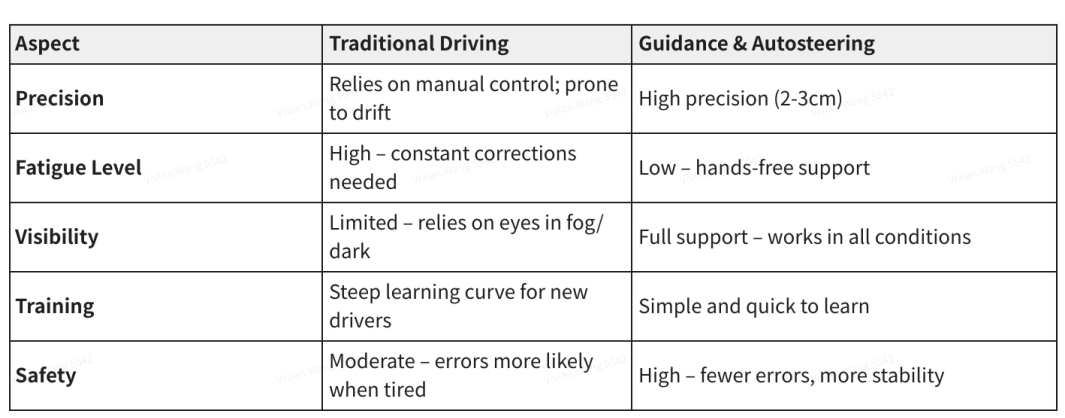
Manual Driving vs. Automation Systems: At a Glance
Real Stories from the Field
The FJD AG1 and AT2 Lite have empowered farmers worldwide to maximize efficiency and achieve centimeter-level precision. From saving fuel to reducing operator fatigue, these systems transform daily labor. These systems are making a big impact in real-world examples:
Case 1: Retrofitting Older Machinery
A farm in Poland recently upgraded a 10-year-old UNIA sprayer with the FJD AG1 for smart spraying control. While retrofitting with other brands often requires weeks of training, the AG1 is so intuitive that installation and field testing were completed in just a few hours. This allowed the farmers to begin precision spraying immediately during the peak season, saving the owner both time and the high cost of purchasing a new machine.
Case 2: Conquering the Tillage
A farming team in Thailand previously spent days on soil preparation. After installing the FJD AT2 Lite, they now navigate their fields with confidence. The system allows them to finish the job on schedule, ensuring the soil is perfectly prepared for the upcoming planting season.
When Is the Best Time to Upgrade?
If you find yourself feeling exhausted after a day in the field, or if you’re worried about the accuracy of your work at night, it’s time to look at an upgrade. The FJD AG1 Guidance System is a perfect starting point for those who want better visibility and less stress. If you want to go all the way to "hands-free" comfort, the FJD AT2 Lite is an affordable, rugged, and easy-to-install option that fits almost any tractor—old or new.
Starting Precision Farming with FJDynamics
The digital shift in farming isn't just about "big data"—it’s about the person in the cab. By reducing fatigue and improving safety, systems like the AG1 and AT2 Lite allow you to work smarter, stay healthier, and get home to your family feeling less exhausted.
Ready to make your workday easier? Click here to explore the FJD AG1 and AT2 Lite or contact us today to see how easy it is to upgrade your current tractor!