In the fast-changing world of farming, everyone wants to grow more while saving time and reducing waste. A great harvest starts with one vital step: seed placement. How you plant a seed determines if it gets enough water, stays safe from birds, and grows strong without being choked by weeds.
Choosing the right tool is about more than just finishing the work—it’s about being precise. Modern seeders have changed everything, moving from simple hand-scattering to high-tech systems. This guide will walk you through the different types of seeders so you can find the best fit for your crops.
Conventional Seeders: The Foundation of Planting
Conventional seeders are often the starting point for many farmers. These tools are generally mechanical or gravity-based and are prized for their reliability and ease of use.
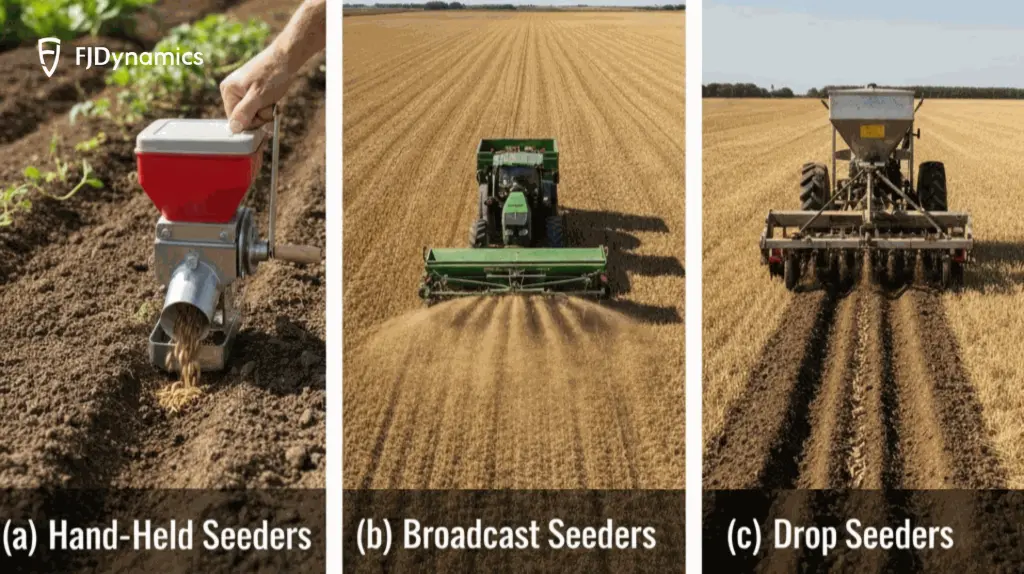
(a) Hand-Held Seeders
For small-scale farmers, hobbyists, or those managing market gardens, the hand-held seeder is an essential tool. They are popular because they are simple to use and very affordable. Most of these tools work by turning a crank or pressing a manual trigger to release seeds as the farmer walks.
- Best for: Tight spaces, uneven terrain, or greenhouse beds where large machinery cannot fit.
- Advantage: Low cost and high flexibility for "spot-planting."
(b) Broadcast Seeders
If farmers need to plant over a huge area very quickly, broadcast seeders are the best choice. These machines scatter seeds across the top of the soil using spinning discs or air fans. Because they throw the seeds out in a wide arc, they are great for covering large fields or pastures in no time.
- Best for: Cover crops, grass, and small grains like wheat or oats.
- Advantage: Speed. It is the fastest way to sow a large field without worrying about row alignment.
(c) Drop Seeders
While broadcast seeders throw seeds outward, drop seeders do exactly what the name implies: they drop seeds straight down. Controlled by gravity, seeds fall from a hopper into furrows at specific intervals.
- Best for: Crops that require specific spacing but don't need high-tech suction.
- Advantage: Improved accuracy over broadcast seeders and less "seed drift" on windy days.
Mechanical Seeders: Stepping Up Productivity
As a farm grows, so does the need for speed and consistency. Mechanical seeders introduce specialized plates and wheels to automate the spacing and depth of the seeds.
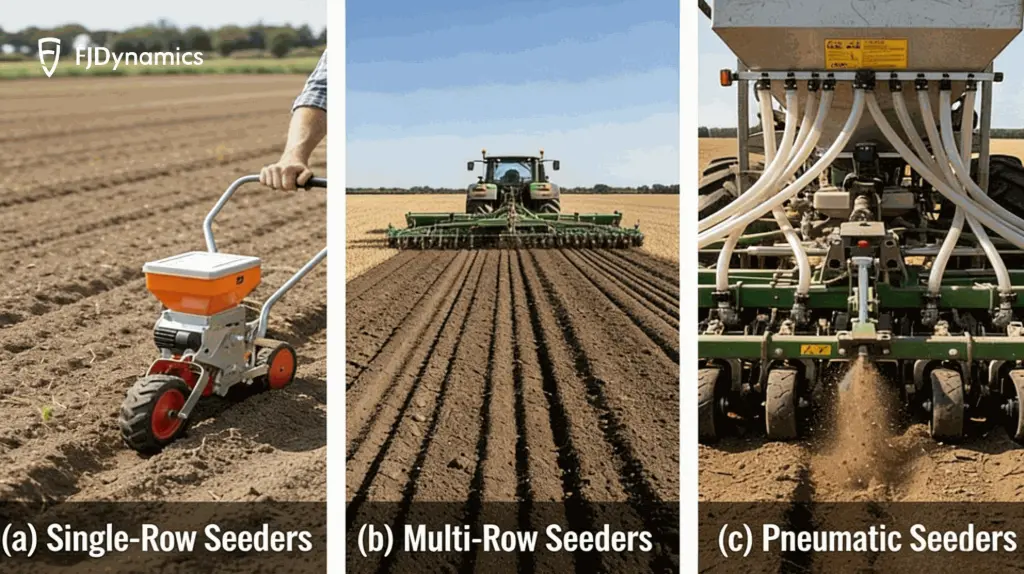
(a) Single-Row Seeders
Commonly pushed by hand or pulled by a small garden tractor, single-row seeders use internal seed plates to regulate exactly how many seeds are dropped per foot. They usually feature a "furrow opener" in the front and a "closing wheel" in the back to bury the seed.
- Best for: Market gardening and specialized vegetable rows.
- Advantage: High depth control and the ability to change seed plates for different crop types (e.g., swapping from radishes to beans).
(b) Multi-Row Seeders
On big commercial farms, saving time is the best way to save money. Multi-row seeders let farmers plant between 4 and 48 rows all at the same time. These machines are usually attached to a tractor and built with strong, heavy frames so they stay steady even when farmers are driving at higher speeds.
- Best for: Large-scale grain or vegetable production.
- Advantage: Massive productivity gains and uniform plant populations across the entire field.
(c) Pneumatic Seeders
Pneumatic seeders represent a significant jump in technology. They use air pressure to move seeds from the hopper through delivery tubes to the soil. This prevents the "bruising" or damage that can sometimes occur in purely mechanical systems.
- Best for: Delicate seeds or irregularly shaped seeds that might get stuck in traditional plates.
- Advantage: Uniform distribution even at high speeds, significantly reducing seed waste.
Precision Seeders: The Future of Farming
For high-value crops where every single seed counts, precision seeders are the gold standard. These machines are designed to place seeds with "millimeter accuracy," ensuring that plants don't compete for nutrients.
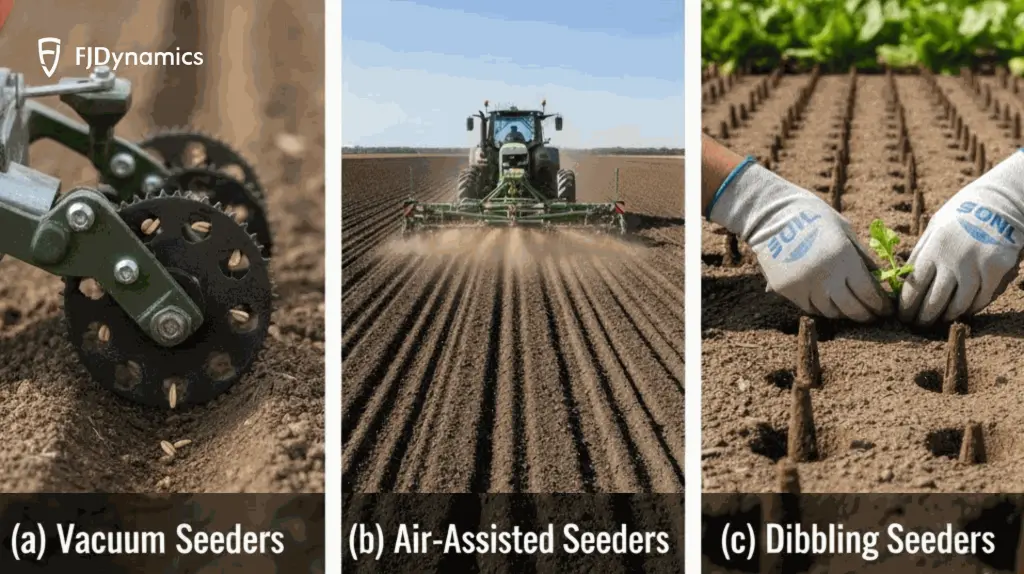
(a) Vacuum Seeders
Vacuum technology is a game-changer for high-value vegetable crops. These seeders use suction to pick up a single seed at a time and hold it against a rotating disc before dropping it into the ground.
- Best for: Onions, carrots, lettuce, and nursery operations.
- Advantage: Near-zero seed doubling or skips. It ensures perfectly even spacing, which is vital for crops that need room to bulb or head.
(b) Air-Assisted Seeders
Air-assisted seeders combine the power of air pressure with precision seed plates. They are incredibly versatile and can handle a wide variety of seed sizes, from tiny canola seeds to large corn kernels.
- Best for: Row crops like corn, soybeans, and cotton.
- Advantage: Excellent depth control and the ability to operate at high speeds without losing accuracy.
(c) Dibbling Seeders
Dibbling seeders are specialized tools primarily used in horticulture. Instead of creating a continuous furrow (a line), they punch individual holes into the soil. This is often used for transplanting young seedlings or for very specific planting patterns in vegetable production.
- Best for: Transplanting seedlings and horticulture.
- Advantage: Protects delicate root systems and ensures the plant is placed at the exact depth required for survival.
Making the Right Choice
In today’s farming world, there is no "one-size-fits-all" tool. A small family farm on a hillside has very different needs than a massive grain farm on the flat plains. By understanding your options—from simple hand-held tools to high-tech vacuum systems—you can pick the right machine that pays for itself over time. The right seeder does more than just make work easier; it helps your crops grow healthier and makes your farm more profitable.
If you are looking to upgrade your current equipment, FJDynamics offers the APS Precision Seeding Control Kit, designed to bring even more accuracy to your planting. If you want to see the product details or try it out before you make a purchase, contact FJD today to learn more.