Farming is a race against time, fuel costs, and tight margins. In recent years, one tool has proven essential for winning that race: tractor GPS. Choosing the right navigation system can be the difference between wasteful overlaps and maximized efficiency. With a dizzying array of options, from simple manual guidance to advanced centimeter-accurate autosteering, where do you start?
We've cut through the noise. This simple guide will walk you through the critical steps, features, and decisions you need to make to select the perfect farming GPS system that pays for itself, season after season.
Why Do You Need Tractor GPS?
Before you look at a single feature, define your goals. Selecting the best tractor GPS becomes simple when you focus on the jobs you need it to do.
Think about your main field operations:
- Mapping & Measuring: Do you need to calculate acreage, map boundaries, or record harvest data?
- Spraying & Fertilizing: Are you aiming to reduce costly overlaps when applying chemicals?
- Precision Planting: Do you need perfectly straight rows and exact seeding placement for maximum yield?
- Operator Comfort/Fatigue: Are you spending long, back-breaking hours in the cab that could be automated?
FJD AS2 navigation system enables precise ridging for sweet potato planting in South Korea
A basic GPS receiver might be enough for simple area measurement, but precision planting demands a complete, high-accuracy auto-guidance system. Understanding your needs will immediately eliminate unnecessary, expensive features.
Manual Guidance vs. Auto-Steering: Where Does Your Money Go?
This is often the first hurdle for farmers deciding on a budget. Is the high extra cost of autosteering truly worth it?
| Feature | Manual Steering GPS | Autosteering System |
| Cost | Affordable entry point | Higher initial investment |
| Accuracy | Good (Sub-meter) | Excellent (Centimeter-level) |
| Field Operation | Require constant driver attention to follow lines | Steer the tractor automatically & operator monitor machine status |
| Key Benefits | Greatly reduce overlap; easy to install; saves fuel. | Eliminate operator fatigue; ensure perfect, repeatable lines; maximum productivity. |
| Payback | Fast, simple savings on inputs. | Maximum savings (input, time, labor) and quicker payback period with the right option. |
For small farms, basic tillage, or tasks like spraying where sub-meter accuracy is sufficient, a manual system is a low-cost investment. It's often an easy-to-use GPS tractor app paired with a simple display, providing live guidance to minimize chemical and seed overlaps.
But for large-scale tasks, autosteering transforms the job. Imagine a 12-hour planting day where the tractor drives itself, keeping the line straighter than you ever could. This system improves operator comfort, saves even more time, and ensures centimeter-level straight lines across every single pass.
FJD AT2 Lite helps a rice planter navigate precisely in the paddy field, Japan
If you work on large farms, spend many hours driving your tractor, or do important jobs like precise planting, then auto-steering is essential because it makes you less tired and more productive for a long time.
9 Steps to Choosing the Right Farming Navigation System
Finding the best fit requires a structured approach. Follow this step-by-step guide to ensure you don't overpay for features you don't need or under-buy a system that can't handle your most critical tasks.
Step 1: Define your required accuracy
This is the most critical step. Different tasks require different levels of GPS precision. Matching accuracy to the job prevents wasteful spending.
| Task | Required Accuracy Level | Example Systems |
| Field mapping/tillage | 1 meter to sub-meter | Basic GPS, manual guidance |
| Spraying/fertilizing | 30 cm (Sub-meter) | Mid-level manual or entry-level autosteering |
| Precision planting/strip-till | 2.5 cm (Centimeter-level RTK) | High-end autosteering (Required) |
Pro Tip: If you plan on any planting or high-accuracy strip-tilling, you must look at systems capable of RTK (Real-Time Kinematic) correction, which provides the repeatable centimeter accuracy you need.
FJD AT2 navigation system helps plant fruit trees at an orchard in the Netherlands
Step 2: Set a realistic budget
Manual systems can start affordably, offering a quick return on investment. Full autosteering can cost significantly more, but the payback—especially on large, high-value fields—can be rapid due to massive time and input savings.
Step 3: Check compatibility
This can help you avoid costly surprises. You need to check if a GPS system works with your specific tractor model before purchase.
- New tractors: Many modern tractors are "steer-ready", meaning the GPS navigation system can integrate directly with factory hydraulics.
- Older tractors: These usually require external components (e.g., an electric steering wheel, hydraulic valve) to enable auto-steering. Make sure the system offers necessary adapters.
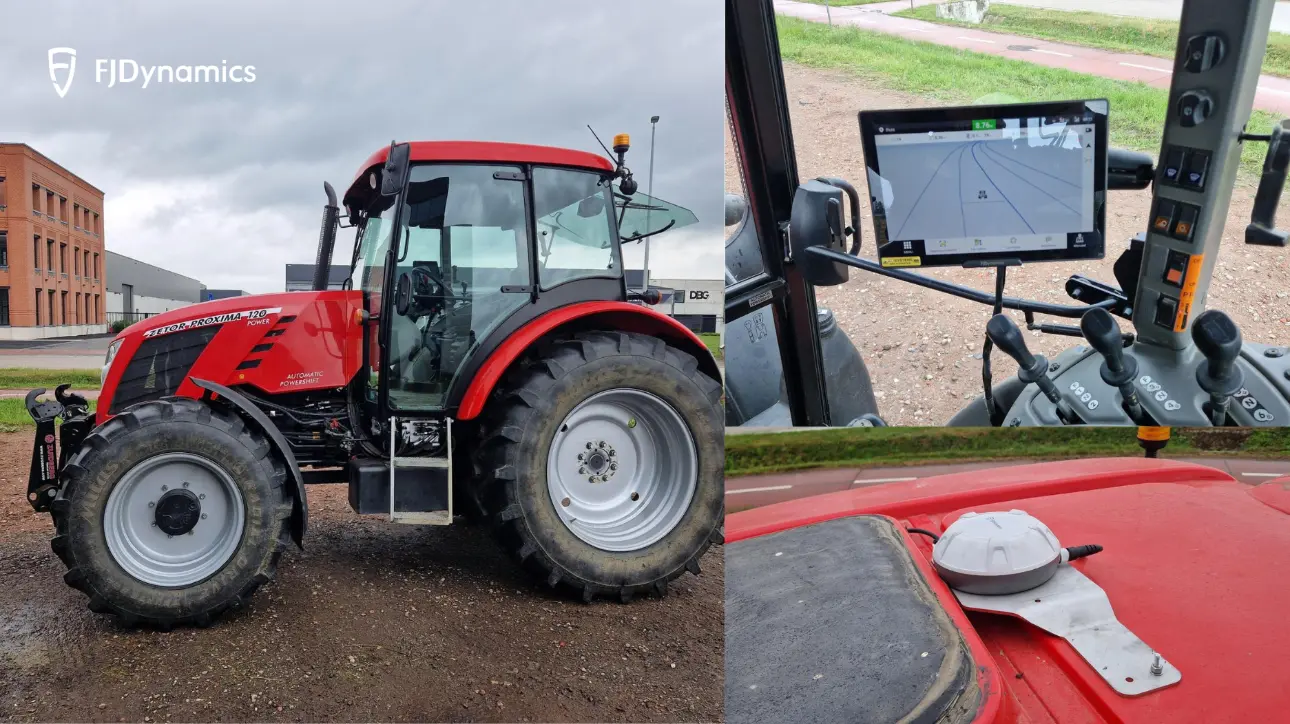
A Zetor tractoter was installed with FJD AH2-Max RTK-GPS system in Belguim
Step 4: Assess update rate (Hz)
The update rate is how often the system refreshes your position. It affects how smooth your steering is.
- Manual guidance: A 5 Hz rate is usually fine.
- Autosteering: You need a faster update rate, typically 10 Hz or more, to maintain smooth, precise control at speed.
Step 5: Prioritize usability and flexibility
The best system is the one your team will actually use.
- Ease of use: Is the interface clear? Can a new operator learn it quickly?
- Transferability: Can the display and receiver be easily moved between your tractor, sprayer, and combine? This maximizes your investment.
Step 6: Confirm upgrade paths
A good system grows with your farm. Can you start with manual guidance and later add an auto-steering motor or section control without replacing the entire fleet? Choosing a flexible supplier like FJDynamics is key to future-proofing your investment in agricultural navigation technology.
FJD upgraded a 2014 UNIA sprayer in Poland, adding ISOBUS for precise section control
Step 7: Focus on the "sweet spot" for small farms
For a small farm, look for solutions that combine affordability with multi-machine flexibility. Systems like the FJD tractor navigation system are popular because they offer solid cm-level accuracy, support both manual and automatic options, and have a price point that makes the initial investment manageable. The goal is efficiency, not overwhelming complexity.
Step 8: Research supplier support and service
The hardware is only as good as the team behind it. A breakdown during planting or spraying can cost you thousands.
- Support: Do they offer fast, helpful customer support during peak season?
- Updates: Do they provide regular software updates to improve performance?
- Warranty: What is the warranty period, and is service readily available?
Choosing a trusted supplier is one of the smartest steps you can take to protect your investment and ensure stress-free field operations.
Step 9: Compare Tractor GPS Systems
Finally, compare the complete packages. Don't just compare price; compare the features you need against the features offered. A system with a lower initial cost might require expensive add-ons later, while a slightly higher-priced system might include everything you need right out of the box.
Farming Smarter with the Right Tractor GPS System
Choosing the best tractor GPS means finding the right tool for your farm, not just the newest one. The key is matching the system to your jobs and your budget. A good GPS saves you time and money, helping you work better in every field. Whether you pick simple manual steering or full automatic steering, the correct GPS quickly becomes one of your most important farm assets.
Do you have an older tractor model and want to know more about the best budget-friendly auto-steering motor options? Contact FJDynamics today, and we'll come out with the right GPS navigation system for your tractor.