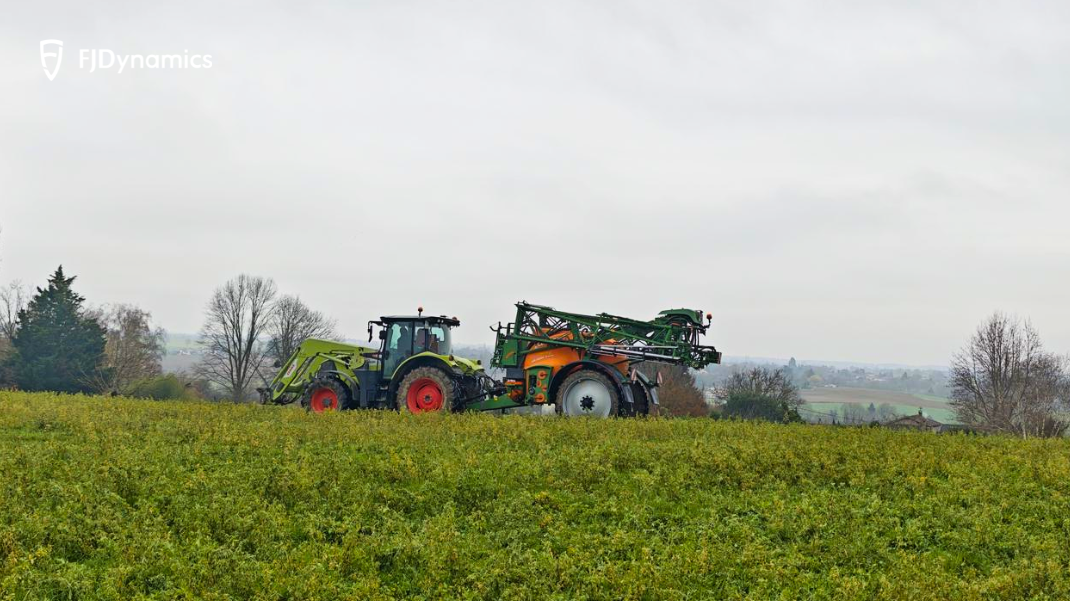
In Ain, Auvergne-Rhône-Alpes, France, farmer Christophe manages a diversified farm producing wheat, barley, rapeseed, and cover crops. Like many European growers, his operations depend heavily on precise and efficient crop protection and fertilizer application, especially during tight seasonal windows.
To improve accuracy and reduce operator workload, Christophe adopted the FJD AT2 MAX Auto Steering System together with ATS-C Automatic Section Control and ISOBUS integration, bringing guidance and implement control into a unified workflow.
From Visual Judgement to Guided Precision
Before adopting auto steering technology, spraying operations relied heavily on visual estimation and operator experience. In fields covered by dense crops or uniform vegetation, it was often difficult to identify previous passes.
As Christophe describes:
“Some fields look like a completely green carpet. There are no clear references.”
To avoid missing areas, overlap was commonly increased, sometimes reaching two to three meters. While this ensured coverage, it also led to unnecessary chemical use and inefficiencies.
Automatic Section Control Changes the Workflow
After introducing FJD AT2 MAX with ATS-C, spraying operations became significantly more automated. Once the first pass is completed and an AB line is established, the system automatically records treated areas. When the boom enters an already sprayed zone, the corresponding sections automatically switch off. As soon as it reaches untreated ground, the sections switch back on automatically.
The entire process is fully automated, requiring no manual intervention from the operator. Christophe noted that he now rarely needs to think about section control, as the system manages it automatically. For irregular fields and complex boundaries, automatic section control helps reduce overlaps and missed areas, improving chemical utilization while ensuring more uniform coverage.
Less Fatigue, More Focus in the Field
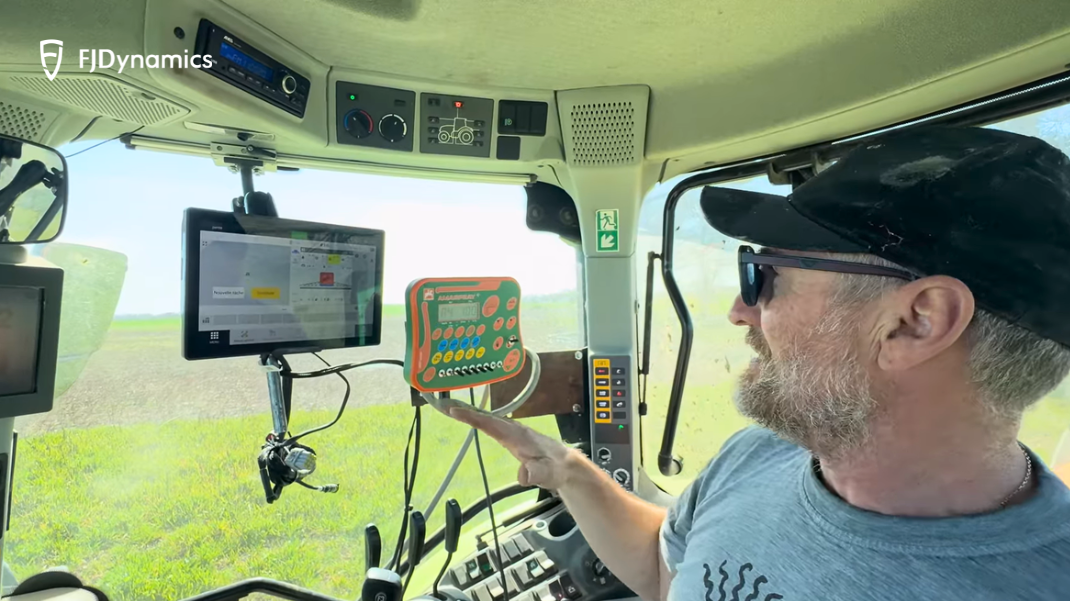
For Christophe, the most noticeable change is not only accuracy but also operator comfort. Previously, spraying required him to simultaneously:
- Drive the tractor
- Track previous passes
- Manage boom sections
- Monitor sprayer performance
- Watch field boundaries
With FJD Auto Steering, the tractor automatically follows the planned guidance line, while the system handles many repetitive tasks. Instead of continuously correcting steering inputs, Christophe can now focus more on machine performance and field conditions. During peak seasons, this reduction in fatigue directly translates into more stable and productive operations.
“The biggest difference is that I’m less tired at the end of the day. Before, I had to watch where I was going constantly. Now the system takes care of many things for me.”
One Integrated System for Spraying and Fertilizing
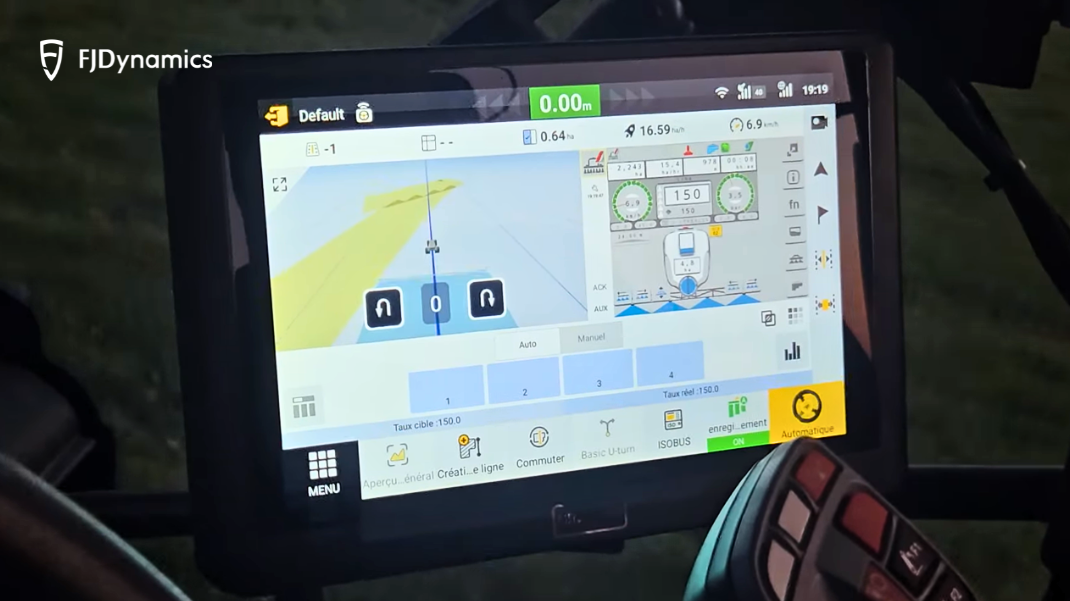
Beyond spraying, Christophe also uses the system for fertilizer application. For him, the real advantage goes beyond auto steering itself. With ISOBUS integration, the sprayer interface is displayed directly on the FJD terminal, allowing all key functions to be managed from a single screen, including:
- Application rate monitoring
- Coverage mapping
- Section control status
- Remaining product tracking
For farms managing multiple fields and performing frequent spraying and fertilizing operations, this integrated workflow significantly simplifies daily operations.
Accurate Application in Complex Field Conditions
During fertilizer application, especially in fast-growing wheat fields, wheel tracks often become invisible. In such conditions, maintaining accuracy becomes challenging without guidance. With FJD auto steering, once the AB line is set, the system ensures consistent spacing across the entire field, even when visual references disappear. This is particularly valuable during nitrogen application in spring, where uniform distribution is critical for crop development.
When operating near roads, ditches, or field edges, Christophe also uses boundary control functions to prevent over-application. By leveraging stored field boundary data, the system automatically adjusts application zones to keep fertilizer within the field while avoiding unnecessary spread beyond boundaries. This improves application accuracy, reduces product waste, and helps minimize environmental impact.
Long-Term Value and Reliable Support
One of the key advantages highlighted by Christophe is the long-term usability of field data. Once field boundaries and AB lines are created, they are stored in the system and can be reused across future seasons. He noted that “the first year requires some setup, but after that everything is saved,” which significantly reduces setup time and improves operational consistency year after year.
Alongside long-term data usage, Christophe also emphasized the importance of technical support during system adoption. Whenever adjustments were needed, the FJD team was able to connect remotely and assist with configuration. “Whenever there’s an issue, they can remotely connect and help adjust settings,” he explained. This responsive support helped ensure smooth operation during early use and strengthened overall confidence in the system.
Conclusion
For Christophe, the value of FJD Auto Steering goes far beyond straight-line driving. It is reflected in every stage of field operation—from reducing overlaps and improving chemical efficiency to enabling automatic section control, higher application accuracy, and more consistent work quality across spraying and fertilizing tasks.
Beyond operational improvements, the system also helps simplify daily workflows by bringing guidance, implementing control, and field data management into a single platform. Stored field boundaries, AB lines, and historical operation data further enhance long-term efficiency and consistency across seasons. When asked about the investment, Christophe’s view is direct:
“If you can afford it, I would recommend it.”
For him, the real value lies in reduced fatigue, improved productivity, and a more reliable way of working in the field. As he summarizes his experience:
“Once you start using it, you don’t want to go back to the old way.”
To explore how FJD Auto Steering can improve efficiency in spraying, fertilizing, and other field operations, discover more about AT2 MAX and ATS-C integrated solutions designed for modern precision farming workflows.