In the modern world, GPS is everywhere. It’s in our pockets, our cars, and even our watches. For most of us, it’s the tool that helps us find the nearest gas station or navigate a new city. But for a farmer, GPS means something much more significant. It is no longer just a luxury; it has become an essential tool that helps the agricultural world work more accurately, efficiently, and sustainably.
From planting perfectly straight rows to ensuring that every drop of fertilizer lands exactly where it's needed, GPS is reshaping everyday fieldwork. However, there is a common question among those looking to upgrade their tech: "Why can't I just use my phone?"
While a smartphone or a car's dashboard navigation works great on the road, these systems fall short when they meet the demanding reality of a farm. To truly improve a farming operation, you need a dedicated agriculture GPS guidance system.
What Is Agriculture GPS?
At its core, agriculture GPS is a specialized positioning system built specifically to support fieldwork. While a regular GPS tells you where you are on a map, an agricultural system tells your machinery exactly how to interact with the earth.
These systems are typically made up of three main parts:
1. The Receiver: An antenna (often a tractor GPS receiver) mounted on the roof of the cab to catch satellite signals.
2. The Display: A rugged touchscreen inside the cab that shows the farmer their real-time guidance, field maps, and coverage.
3. The Control System: This is where magic happens. Based on real-time positioning data, the tractor’s autosteering system (control terminal) connects with the implement (like a sprayer or seeder) to control how the machine moves.
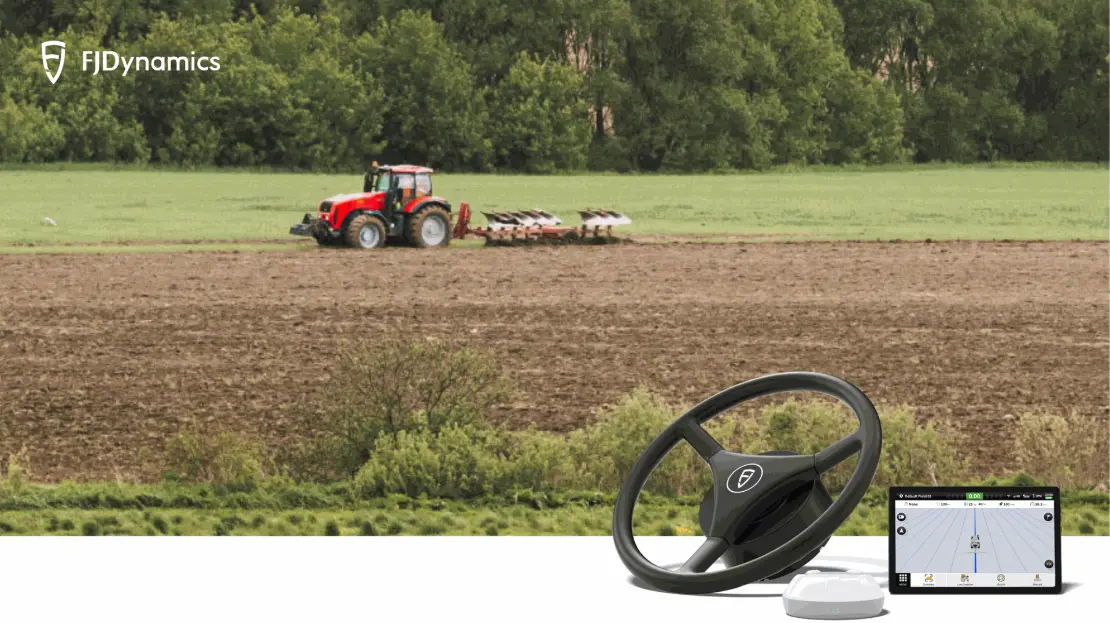
FJD AT2 Lite Auto Steer System
Modern solutions, like those provided by FJDynamics, combine GNSS (Global Navigation Satellite Systems, including GPS) with RTK (Real-Time Kinematic) differential corrections for real-time positioning. This combination allows for high-precision positioning, often with a margin of error of just a few centimeters.
The Big Difference: Centimeters vs. Meters
The most significant difference between regular GPS and farm GPS is accuracy. When you use Google Maps to drive to a restaurant, being "accurate" within 5 or 10 meters is perfectly fine—you can see the building from the street. However, if you are planting corn and your GPS is off by 5 meters, you will end up with overlapping rows, wasted seed, and a messy field that is difficult to harvest.
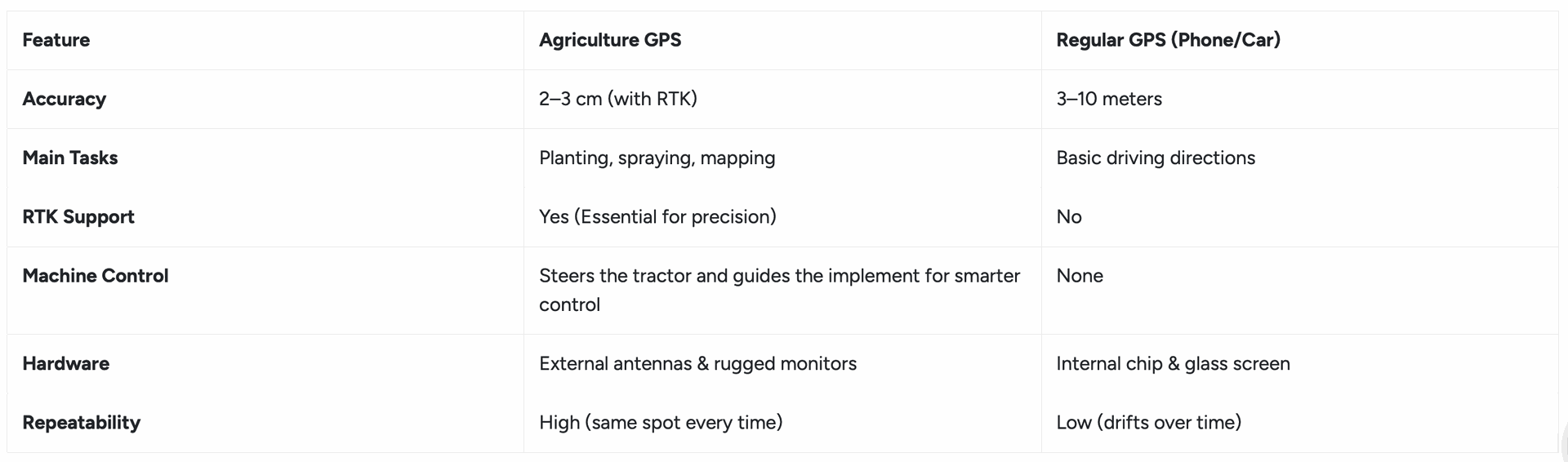
- Regular GPS: Usually offers accuracy within 3–10 meters.
- Agriculture GPS: When paired with an RTK signal, it offers accuracy within 2–3 centimeters.
This level of precision is critical for repeatability. It means you can drive a path today, and come back weeks later for spraying or harvesting, knowing exactly where those same rows are located.
Why Every Centimeter Counts
You might wonder if a few centimeters really matter in a massive 100-acre field. The answer is a resounding "Yes". Precision farming is all about reducing waste.
Reducing Overlaps and Gaps
Without GPS, drivers naturally overlap their passes to make sure they don't miss any spots. This means they are using more fuel, more seeds, and more chemicals than necessary. A dedicated autosteering system, like the FJD AT2 Lite, ensures that each pass sits perfectly next to the previous one.
FJD ATS Lite enables precise straight-line driving to avoid overlaps in Türkiye
Section Control
Agriculture GPS does more than just show the way; it talks to the equipment. With section control, the GPS knows exactly where the sprayer has already been. If the boom passes over an area that has already been sprayed, the system automatically shuts off those specific nozzles. This prevents "double-dosing" crops and saves a significant amount of money on inputs.
FJD AG1 achieves automatic section control for precision spraying
Fatigue Reduction
Driving a tractor for 12 hours while trying to keep a perfectly straight line is exhausting. With an autosteering system guided by high-precision GPS, the tractor handles the steering, allowing the farmer to focus on the performance of the implement and the safety of the operation.
Specialized Features You Won't Find on a Phone
Standard navigation systems were built for travel, not for the complex logic of a farm. Here are a few features unique to agricultural systems:
- Implement Guidance: It’s not just about the tractor; it’s about what’s behind it. Specialized GPS can account for "implement drift" on hillsides to ensure the seeder stays on track even if the tractor slides slightly.
- Task Logging: These systems act as a digital diary. They record exactly when a field was worked, how much product was applied, and what the weather conditions were. This data is essential for long-term planning.
- Variable Rate Application (VRA): High-end farm GPS can read prescription maps. If one part of the field is more fertile than another, the GPS tells the machine to drop less fertilizer there and more in the areas that need it.
Comparison: Agriculture GPS vs. Regular GPS
Who Should Make the Switch?
If you are a gardener or managing a very small hobby plot, a smartphone app might be enough to mark your boundaries. However, for any commercial operation—large or small—dedicated GPS is an investment that usually pays for itself in the first few seasons.
Whether you are handling regenerative agriculture, organic farming, or traditional large-scale grain production, the goal is the same: use less to grow more. If your work depends on consistency and you want to stop "eyeballing" your rows, it’s time to move beyond regular GPS.
Frequently Asked Questions
Can I use my smartphone GPS for farming?
Only for very basic tasks, like marking a rock in a field or finding a gate. It lacks the "correction signals" needed to stay accurate. Smartphone GPS "drifts"—meaning your position on the screen will shift even if the tractor is standing still. This makes it dangerous for tasks like spraying or planting.
Do I really need RTK?
If you want to do autosteering or planting, yes. RTK is the correction signal that takes you from "close enough" to "perfect." Without it, your rows won't be straight enough to use during harvest time.
Is it hard to set up?
Most modern systems like the FJD AG1 and AT2 Lite are designed to be "plug-and-play." You only need to perform some calibration and field mapping during initial use. Once the system knows the dimensions of your tractor and implements, it becomes as simple as following a line on a screen.
What happens if I lose the signal?
High-quality farm systems are designed to handle brief interruptions. They can often "buffer" the data or switch to a secondary satellite network to keep you moving. However, for the best results, having a clear view of the sky and a reliable RTK base station (or network) is key.
Conclusion
At the end of the day, agriculture GPS is about confidence. It’s the confidence to work through the night or in dusty conditions because you know the machine is on the right path. It’s the confidence of looking at your bank account at the end of the year and seeing the savings from reduced fuel and chemical waste. By choosing a system built for the dirt rather than the highway, you aren't just buying a navigator—you’re buying a partner for your farm’s future.
FJDynamics offers a wide range of tractor GPS guidance systems, from entry-level AG1 guidance system to beginner-friendly AT2 Lite autosteering system. If you aren't sure which one is right for you, contact us today. We can help you find the best solution, so you can start using advanced GPS on your farm!
[Discover AG1] | [Discover AT2 Lite] | [Book a Demo]